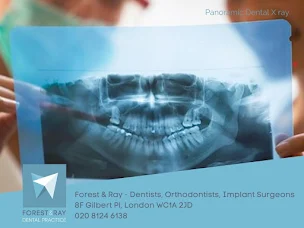
Single tooth and panoramic dental X-ray W1, Central London
At Forest & Ray Dental Practice, we provide a full range of dental X-ray services, including:
Single tooth X-rays
Bitewing X-rays
Panoramic dental X-rays (OPG / Orthopantomogram)
Dental X-rays are often required before treatments such as root canal therapy, tooth extractions, dental implants, orthodontics and oral surgery. Having accurate imaging ensures that treatment is safe, predictable and tailored to your individual dental needs.
Forest & Ray's highly experienced dental team collectively holds over 108 years of expertise in dentistry, ensuring exceptional care and knowledge for our patients.
🦷 Forest & Ray is a private dentist in London (Holborn, Camden) practice offering a wide range of treatments (basically everything), same-day appointments 7 days a week and affordable prices. The key behind a beautiful smile is self confidence, and success. At Forest & Ray we ensure to help you to the best of our ability. If you place your trust in us, we will make sure you achieve your goals and maintain oral hygiene to the maximum of its capacity. Regardless of any age or condition, we promise painless treatments and a professional team.
What is Dental X-Ray (Dental radiography)?
Dental X-rays (also known as dental radiographs) are diagnostic images that allow dentists to examine areas of the teeth, jawbone and surrounding structures that are not visible during a standard clinical examination.
They help detect:
hidden tooth decay,
infections beneath the gum line,
bone loss,
impacted teeth (such as wisdom teeth),
and problems affecting tooth roots or jaw alignment.
Dental radiographs are a necessary procedure to many dental treatments. They may become necessary if you are planning on getting endodontics, meaning root canal treatments and any other treatments dealing with the inside of the teeth, dental implants, tooth extractions (especially wisdom teeth removal) and most oral surgery procedures. Because things change in your mouth very quickly, dental X-rays older than three months cannot be used as the basis of dental treatment. There are basically three different kinds of X-rays to choose from.
Types of Dental X-Rays We Offer
Single tooth X-rays
Sometimes only one tooth is affected by the dental treatment that will be performed. In these cases, an X-ray of a single tooth, or 2-3 teeth maximum is enough. This has the lowest dose of gamma radiation and is the easiest to make. Results from these X-rays are instantaneous, and anything the dentist wishes to see should be apparent immediately. Used frequently during root canals and easier tooth extractions.
Bitewing X-Rays
Bitewing X-rays check the molars of a given side of your face, and are a little bit bigger and more complex than single tooth X-rays. These X-rays give an idea about what is going on in the back of the mouth, and how the teeth align and how the molars are doing. Usually, bitewing X-rays can give us information about the top and bottom row of teeth, the jawbones, and how well the teeth align. These are frequently used in orthodontics but can be used for tooth extractions and root canals.
Panoramic Dental X-Ray (OPG)
Panoramic dental X-rays (abbreviated as OPGs which indeed is an abbreviated form of the word Orthopantomogram) allow the dentist to view all of your teeth, their relation to one another, and how they are positioned in your jawbone. They are an overview of all of your teeth and they can give the dentist a very precise idea of how your teeth are aligned with one another. It will also reveal any infection, and what lies beneath your gum line, so that no surprises are had when the dentist ventures there. These types of dental X-rays can become necessary with orthodontic treatment, complicated oral surgery and wisdom tooth extractions, and many other dental treatments.
Wisdom Tooth X-ray
Wisdom teeth often require panoramic dental X-rays to determine their exact position and orientation. If a wisdom tooth is impacted or growing at an angle, an OPG allows the dentist to assess whether surgical removal is necessary and to plan the procedure safely.
This is especially important before wisdom tooth extractions to avoid complications.
Are Dental X-Rays Safe?
Modern dental X-rays use very low levels of radiation. The exposure from a dental X-ray is comparable to everyday background radiation, such as walking through a busy city or taking a short flight.
While all X-rays involve some radiation, the diagnostic benefits far outweigh the minimal risk — especially when untreated infections or dental problems can lead to serious complications if left undetected.
Protective measures, such as digital sensors and shielding when appropriate, further reduce exposure.
Dental x ray cost in London
The cost of a dental X-ray in London depends on the type of image required. A single tooth X-ray is often enough for smaller treatments and costs only £25, making it a quick and affordable diagnostic tool. For more complex cases, such as wisdom tooth removal, dental implants or orthodontic planning, a panoramic dental X-ray may be recommended. This provides a full overview of the mouth and costs £75. At our Central London clinic, all X-rays are carried out with modern digital equipment, ensuring accurate results, minimal radiation and excellent value for money.
The panoramic dental x ray cost is £75 £69.
The single tooth dental x ray cost is £20.
Frequently Asked Questions – Dental X-Ray London
What are dental X-rays and why are they important?
Dental X-rays are diagnostic images that allow the dentist to see parts of your teeth, gums and jawbone that are not visible during a standard examination.
They can reveal hidden cavities, impacted teeth, bone loss, infections, or other underlying problems. By providing this “inside view”, dental X-rays help create an accurate diagnosis and a safe, effective treatment plan.
Are dental X-rays safe?
Yes, dental X-rays are safe. Modern digital X-rays use very low levels of radiation – in fact, less exposure than a short flight or even a day spent in the sun.
To further protect you, dentists use shielding measures such as lead aprons or thyroid collars when necessary. For most patients, dental X-rays are completely safe, including for children, though pregnant women should always inform the dentist beforehand.
How often should I get dental X-rays?
The frequency depends on your individual needs. Patients with healthy teeth may only need X-rays once every 1–2 years.
However, if you have ongoing dental treatments, gum disease, or a history of cavities, your dentist may recommend them more frequently.
The decision is always personalised, ensuring that you only get X-rays when they are genuinely necessary for your oral health.
What types of dental X-rays are there?
There are several types:
Bitewing X-rays show cavities between teeth and bone support.
Periapical X-rays focus on one or two teeth from root to crown.
Panoramic X-rays provide a full view of your entire mouth, jaw and sinuses.
3D Cone Beam CT scans are advanced images often used for implants or complex cases.
Your dentist will choose the type that best fits your situation.
Do dental X-rays hurt?
No, dental X-rays are completely painless. You may need to bite down on a small plastic holder while the image is taken, which can feel slightly uncomfortable for a few seconds, but it’s never painful.
The process is quick, safe and completed within minutes, making it an easy step in your consultation or treatment.
Tooth x-rays Infographic
Need help before booking?
Leave your details and our team will call you back to help you choose the right treatment and appointment.
We are located in Camden, Holborn close to Westminster W1 near Soho, London
Our address is: 8F Gilbert Place, London, WC1A 2JD. About Camden: Lincoln's Inn Fields is a neighbourhood in the extreme south of the borough that is only 500 metres from the Thames. The northern part of the borough is home to Kentish Town, Hampstead, and Hampstead Heath, which are less populous districts. Numerous parks and open areas may be found in the London Borough of Camden. City of Westminster (near Soho, London) and the City of London are the next-door boroughs, followed by Brent to the west of what was once Roman Watling Street (now the A5 Road), Barnet and Haringey to the north, and Islington to the east. It encompasses all or a portion of the following postcode areas: N1, N6, N7, N19, NW1, NW2, NW3, NW5, NW6, NW8, EC1, WC1, WC2, W1, and W9. The borough of Camden also includes Bloomsbury, known for its garden squares. To the west, the fashionable district of Marylebone is rich in shops and restaurants, while the prestigious Mayfair extends slightly into Camden. Covent Garden, famed for its entertainment and market, adds to Camden's vibrancy. Bordering the east of the borough are Clerkenwell and Farringdon, hubs for the design industry and renowned for their mix of old and new architecture. Although Lambeth and South Bank are located south of the Thames and not within Camden, they contribute to the broader cultural scene that Camden residents can easily access. To the east of Camden, beyond Islington, lies the diverse and bustling borough of Hackney, which provides a distinct cultural blend of its own.
Forest & Ray - Dentists, Orthodontists, Implant Surgeons
We use information collected through cookies and similar technologies to improve your experience on our site, analyse how you use it and for marketing purposes.
Your privacy settings
We and our partners use information collected through cookies and similar technologies to improve your experience on our site, analyse how you use it and for marketing purposes. Because we respect your right to privacy, you can choose not to allow some types of cookies. However, blocking some types of cookies may impact your experience of the site and the services we are able to offer. In some cases, data obtained from cookies is shared with third parties for analytics or marketing reasons. You can exercise your right to opt-out of that sharing at any time by disabling cookies.
These cookies and scripts are necessary for the website to function and cannot be switched off. They are usually only set in response to actions made by you which amount to a request for services, suchas setting your privacy preferences, logging in or filling in forms. You can set your browser to block oralert you about these cookies, but some parts of the site will not then work. These cookies do notstore any personally identifiable information.
Analytics
These cookies and scripts allow us to count visits and traffic sources, so we can measure and improve the performance of our site. They help us know which pages are the most and least popular and see how visitors move around the site. All information these cookies collect is aggregated and therefore anonymous. If you do not allow these cookies and scripts, we will not know when you have visited our site.
Embedded Videos
These cookies and scripts may be set through our site by external video hosting services likeYouTube or Vimeo. They may be used to deliver video content on our website. It’s possible for the video provider to build a profile of your interests and show you relevant adverts on this or other websites. They do not store directly personal information, but are based on uniquely identifying your browser and internet device. If you do not allow these cookies or scripts it is possible that embedded video will not function as expected.
Marketing
These cookies and scripts may be set through our site by our advertising partners. They may be used by those companies to build a profile of your interests and show you relevant adverts on other sites. They do not store directly personal information, but are based on uniquely identifying your browser and internet device. If you do not allow these cookies and scripts, you will experience less targeted advertising.
Facebook Advanced Matching
Facebook Advanced Matching can improve ads attribution and conversion tracking. It can help us reach better-targeted custom audiences through our ads. When possible, we will share with Facebook hashed information like your name, phone, email, or address.
Facebook CAPI
Facebook Conversion API Events (CAPI) help us better understand how you interact with our websites. They allow us to measure the impact of our ads on the website's conversions and they improve ads targeting through custom audiences. When possible, we might share with Facebook information like name, email, phone, address.